
INOMER is a mission-driven company (société à mission) under France’s 2019 PACTE Law, with social and environmental purpose embedded at the heart of its work.
Explore the story of Realistic Optimism: Science & Culture for a Livable Planet, held on 16 July 2026 as an activity under the umbrella of the International Decade of Sciences for Sustainable Development (IDSSD), led by UNESCO.
We help drive positive change and impact for people and the planet.


We support decision-makers and practitioners in advancing strategies and initiatives that drive innovation-led, inclusive, equitable, and sustainable development.
We support multilateral organisations, donors, governments, public institutions and practitioners in designing, implementing and evaluating policies, programmes and initiatives that contribute to sustainable development, climate action, just transition, social inclusion and stronger innovation ecosystems.
Our work connects evidence with practice. We combine policy analysis, research, stakeholder engagement, systems thinking and monitoring, evaluation and learning to help organisations understand complex challenges, make informed decisions and adapt their actions over time.
INOMER is a mission-driven organisation, société à mission under France’s 2019 PACTE Law, working to advance ecological and social transformation through knowledge, innovation and responsible action.
Collaboration is central to how we work. We partner with governments, international organisations, research and innovation actors, businesses, civil society and communities to co-create practical solutions grounded in both global knowledge and local realities.
Across our advisory work, evaluations and mission-driven initiatives, we aim to help institutions and ecosystems move from strategy to implementation, from knowledge to application, and from ambition to positive and durable impact for people and the planet.

Our services
Policy, Strategy & Institutional Advisory
We support decision-makers and institutions in assessing challenges, setting priorities and designing policies, strategies and governance models that enable innovation-led, human-centred and sustainable transformation. Our work helps institutions move from diagnosis to implementation, with practical recommendations grounded in evidence, context and stakeholder needs.
Sustainability, Climate Action & Just Transition
We support multilateral organisations, donors, governments, policymakers and practitioners in advancing just, green and climate-resilient transitions. Our work covers just transition roadmaps, climate action, green and blue economy, sustainability-oriented innovation and One Health that respond to the needs of people, economies and ecosystems.
KTT and Inclusive Innovation & Ecosystem Building
We help transform knowledge, research and ideas into practical applications, partnerships and impactful outcomes. Our work supports knowledge and technology transfer, inclusive innovation ecosystem development, validation and assessment processes, and collaboration between science, industry, policy, society and communities.
Monitoring, Evaluation & Sociatal Impact
We design and implement rigorous, fit-for-purpose monitoring, evaluation, learning and impact assessment approaches for policies, institutions, programmes and initiatives. Our work combines theory-based and mixed-methods approaches to support accountability, learning, adaptive decision-making and credible evidence on results and impact.

Our tools
INOMER develops and applies practical tools and frameworks to help institutions, ecosystems and innovators assess potential, strengthen performance, validate ideas and translate knowledge into meaningful application for society, policy and the economy. These tools combine evidence, expert judgement, stakeholder engagement and structured analysis to support better decisions and more purposeful action.
REITI Compass (Research Excellence & Innovation for Transformative Impact)
REITI Compass is INOMER’s framework for assessing the performance, potential and future development pathways of research and innovation institutions. It combines institutional analysis, stakeholder consultation and benchmarking to identify strengths, gaps and opportunities for improvement.
The process supports the co-creation of a strategic roadmap with institutional leadership, staff and relevant stakeholders. It helps define priority areas, practical steps and implementation pathways to strengthen research excellence, societal relevance, meaningful partnerships and long-term impact.
PROPEL (Patent Review for Optimised Prioritisation and Efficient Licensing)
PROPEL supports research-driven institutions in reviewing and prioritising patents, technologies and research-based assets with potential to contribute to societal, environmental and economic challenges. It combines structured screening, data-informed analysis and expert review to help institutions identify which assets may warrant further development, partnership, licensing or investment.
The process helps knowledge and technology transfer teams use their resources more strategically, focus engagement with industry and partners, and strengthen the pathway from research outputs to responsible and meaningful application.
IMPACT Pathways
IMPACT Pathways supports institutions, programmes and mission-driven initiatives in clarifying how their activities are expected to contribute to social, environmental and economic change. It helps teams define impact pathways, identify assumptions and risks, align stakeholders around shared objectives, and strengthen the connection between strategy, implementation, learning and results.
The process combines theory of change thinking, stakeholder engagement, evidence review and practical planning to help organisations move from ambition to action. It supports more coherent programme design, adaptive implementation and credible evidence on contribution to long-term impact.


Our work
Our expertise spans a wide range of areas across economic and social sectors. Environmental sustainability, climate change, and social inclusion -with a focus on women, youth, Indigenous peoples, and disadvantaged communities- are cross-cutting themes in the majority of our assignments.
We have successfully delivered both global and national initiatives across more than 90 countries, spanning all world regions. Our work with international organizations, national governments, and other innovation ecosystem actors enables us to support diverse stakeholders, including ministries, high-level councils, research institutes, universities, innovation agencies, technology transfer offices, science and technology parks, incubators, accelerators, and research and innovation clusters.
Many of our projects are secured through successive contracts via competitive bidding, reflecting both the high quality of our work and the sustained satisfaction of our clients. INOMER is also an Approved Vendor of the World Bank Group, a distinction that validates our expertise, experience, and commitment to service excellence.
Some key examples of our work:
Societal Impact Assessment at LISER, Luxembourg (2026)
Mid-term Evaluation of the UN Ocean Decade (2024-2025)
Just Energy Transition in Uzbekistan (UNECE, ILO, UNDP, 2025)
Capacity building on innovation program design in Peru (PROCIENCIA, 2022)
Just Energy Transition in Southern Asia (ILO, 2021)
Evaluation of IDRA for IDRC, Canada (2025)
Reforming Research Institutes in Serbia & Romania (World Bank, 2020-2025)
REITI Compass Design and Progress M&E for UNAM (2025-2026)
Evaluation of the Flanders-UNESCO Science Trust Fund (2023)
Technology needs assessment in Asia and Africa (UNOPS, 2021)
Just Green Transition in Uzbekistan for AFD & Expertise France (2026)
Impact Report for EIT Manufacturing (2024-2025)
STI4SDGRoadmaps (JRC, European Commission 2024)
MOPAN assessment of the ILO (OECD, 2020-2021)
Evaluation of Credit Enhancement Program in Jamaica (2023)

SHARE-for-IMPACT: Turning purpose into action
SHARE-for-IMPACT is INOMER’s impact initiative, using science, culture, the arts and education to help fulfil its mission for people and the planet. It empowers young people and strengthen communities to create inclusive, sustainable impact.
Through youth programmes, cultural events and creative collaborations, SHARE-for-IMPACT brings INOMER’s mission-driven commitment to life by supporting climate responsibility, social justice and democratic values.
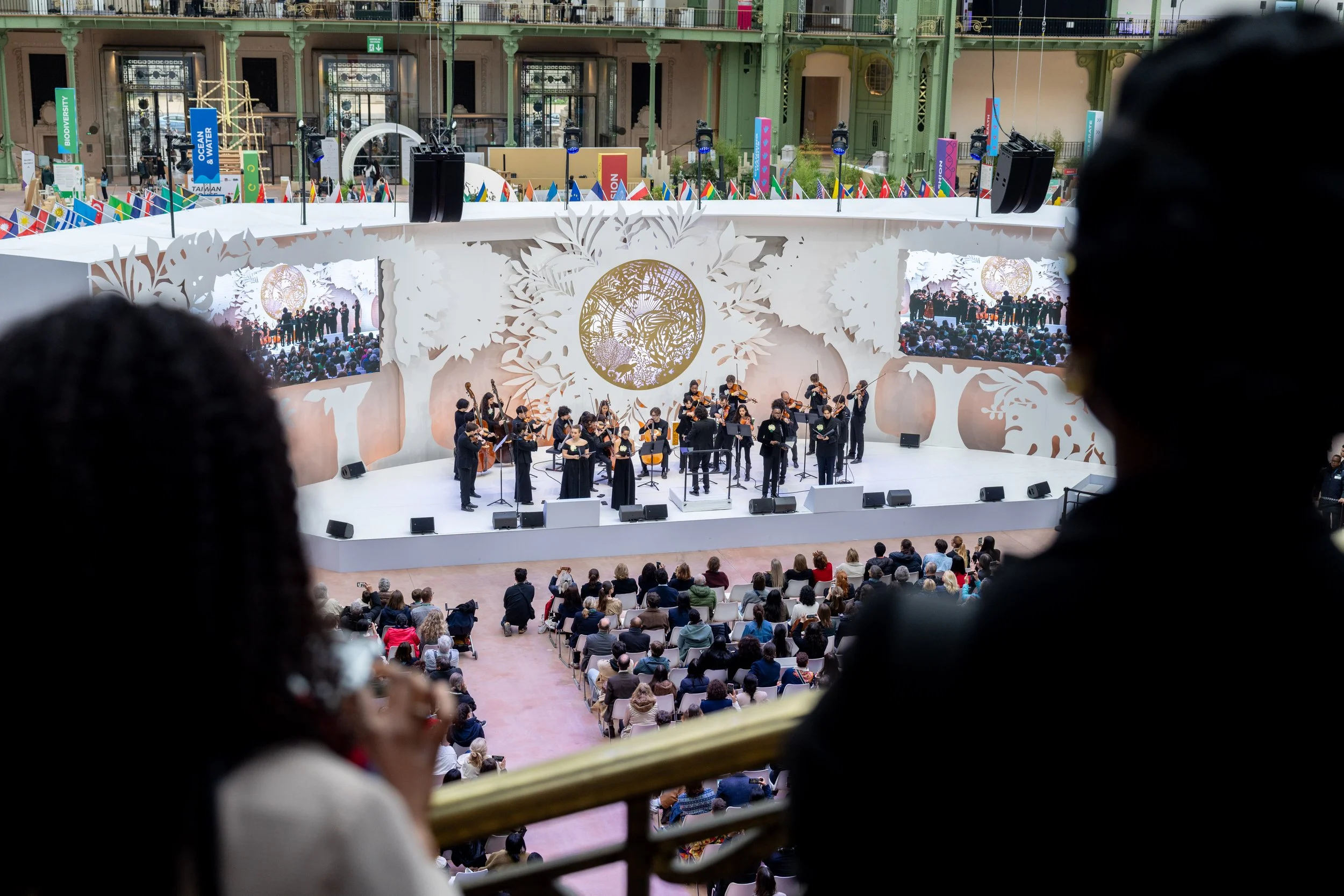
In 2026, INOMER and SHARE-for-IMPACT are contributing to the 2026 Global Conference of the International Decade of Sciences for Sustainable Development, convened by UNESCO with performances by SHARE Ensemble and its Artistic Director Bartu Elci-Ozsoy in Paris. INOMER and SHARE-for-IMPACT are also organising an official side event ‘Realistic Optimism: Science & Culture for a Livable Planet’,bringing together science, culture, sustainability and public engagement. The event highlight how interdisciplinary dialogue, artistic expression and youth participation can help turn knowledge into action for a livable planet.
In 2026, INOMER also partnered with ChangeNOW to bring SHARE-for-IMPACT’s mission to one of the world’s leading gatherings for environmental and social innovation, connecting science, culture and the arts to inspire action for a more sustainable future.
Through We-LEAD Now!, SHARE-for-IMPACT supports young people in becoming informed, creative and engaged changemakers. The programme combines learning, dialogue, artistic expression and community action to help participants address climate and sustainability challenges while strengthening leadership, inclusion and democratic participation.
In 2025, we welcomed a parliamentary delegation from Ghana to Paris for a special edition of the Climate Dialogue, marking the 10th anniversary of the Paris Agreement. This high-level event provided a platform for European-African exchange on climate policy and governance, bringing together Ghanaian leaders and international experts to reflect on progress, confront shared challenges, and co-develop pathways for stronger legislative leadership in climate adaptation, mitigation and diplomacy. By connecting institutions such as UNESCO, the OECD, UNEP, national and European Union bodies, NGOs and the EU Climate Pact Ambassadors network with Ghanaian policymakers, the Dialogue reaffirmed our commitment to advancing meaningful, cross-continental collaboration for a resilient and just global climate future.
Learn more about SHARE-for-IMPACT & partner with us to turn knowledge and creativity into action.
Our mission in practice
As a mission-driven company, “société à mission” under France’s 2019 PACTE Law, INOMER works to turn knowledge, innovation and partnerships into practical progress for people and the planet.
We combine evidence-based methods, digital tools, participatory processes and adaptive management to support ecological and social transformation. Our work is designed to help institutions and ecosystems move from analysis to action, from strategy to implementation, and from ambition to measurable progress.
Collaboration is central to how we work. We partner with institutions, policymakers, practitioners, researchers, entrepreneurs, artists, young people and communities to co-create solutions grounded in global knowledge and local realities.
Across our assignments and mission-driven initiatives, we aim to strengthen local capacities, support responsible innovation, encourage knowledge exchange and help ideas evolve into practical, inclusive and sustainable outcomes.

Our values
At INOMER, our work is shaped by principles that ensure integrity, inclusivity, and sustainability in everything we do.
These values guide our research, advisory, and evaluation processes, ensuring meaningful and lasting results.
-
Embedding environmental, social, and economic resilience in everything we do.
-
Ensuring transparency, objectivity, and ethical excellence.
-
Using technology for fairness and accountability.
-
Delivering credible, evidence-based insights.
-
Amplifying diverse voices and advancing fairness.
-
Creating impact through partnerships capacity development and co-creation.

Our team
-
Sirin is the President of INOMER with nearly 30 years of experience in designing, implementing, and evaluating strategies and initiatives for transformative change and innovation-driven, inclusive, sustainable development. She created INOMER as a result of a successful management buy-out from Technopolis Group, where she worked as a director and a board member for eight years. She specializes in science, technology, and innovation; knowledge and technology transfer; environmental sustainability; climate change and just transition; entrepreneurship; SME and private sector development; deep tech; and education and skills development. She also teaches at universities in Paris. During her career, Sirin has provided consulting, research, capacity building, and advisory services and led and conducted strategic projects for international organizations (World Bank, OECD, EC, UNESCO, UNDP, EIT, etc.) as well as for governments, public, private and non-governmental organizations. Her experience covers global initiatives as well as assignments in over 90 countries in all world regions. Having provided consulting and capacity-building services in more than 60 countries, Sirin brings broad experience from different contexts, cultures, and organizations to clients. This diverse experience provides her with the unique advantage of offering a holistic view of inclusive and sustainable development and positive impact.
-
Berke has a background in environmental engineering and digital ecosystems, with over 30 years of experience. His expertise spans managing complex innovation projects and developing cutting-edge solutions in the environmental sector as well as policy implementation and project management in green transition and digital transformation for sustainable development. Berke is passionate about leveraging science, technology, and innovation to address global challenges, and he has worked with various industries and institutions to drive impactful change through strategic innovation initiatives.
-
Jerome, a senior consultant of INOMER, is an evaluation expert with more than 18 years of professional experience in a wide range of fields, including science, technology and innovation, poverty reduction, and agriculture, He has an extensive track record in designing and implementing evaluation processes and monitoring systems at project, program or institutional levels, notably using results-based approaches. Jerome has conducted or managed about 45 evaluations and various research studies using both qualitative and quantitative methods. He mainly worked on the projects of UN agencies and other multilateral organizations. He has a good understanding of the SDGs as well as the African context: for example, in 2019, he reviewed the United Nations Monitoring Mechanism of Development commitments toward Africa for the UN Office of the Special Adviser on Africa, and, notably, he has worked in the DRC and has conducted evaluations in Ghana and Tanzania.
-
Catherine is a researcher with a decade of professional experience in agriculture, climate change, fisheries, and natural resource management. She holds a PhD in Environmental and Geographical Sciences from the University of Cape Town and specializes in social-ecological systems, with a focus on human dimensions in marine fishing systems and environmental sustainability. Catherine has experience designing environmental monitoring frameworks, including managing and conducting fieldwork surveys and data quality assessments. She supports monitoring, evaluation, and learning (MEL) activities related to ocean-funded programs taking place in the Global South. She also contributes to developing and testing frameworks that integrate human rights considerations into global seafood sustainability assessments. Catherine has extensive research experience in social-ecological issues related to coastal livelihoods and small-scale fisheries, focusing on communities in South Africa and Mauritius. She has coordinated research teams across sub-Saharan Africa and Southeast Asia, working in diverse social-ecological contexts and providing critical insights into the human dimensions of natural resource management.
-
Alix has 19 years of experience working with multilaterals and national organizations (e.g. African Development Bank and Crédit Agricole), Government Ministries in France, New Zealand, Germany, New Caledonia), NGOs such as WWF, ICUN, international development organizations (e.g GEF, UNIDO, EU, IRENA) and academic institutions (Institute for Regional Maritime Security of West Africa, Liverpool Seabed Governance Institute, University of New Caledonia) in a wide range of topics such as sustainable fisheries, reduction of the marine plastic pollution, climate change, land degradation and biodiversity. She is a member of the World Commission on Environmental Law, member of the Advisory Board of the Deep-Ocean Stewardship Initiative, a global network which seeks to integrate science, technology, policy, law and economics to advise on ecosystem-based management of resource use in the deep ocean; and maritime development expert for the UN regular process for World Ocean Assessment, renewable energy expert for the Ren’s 21 Global Renewable Status and deep-sea energy and mineral expert for the International Network for Scientific Investigation of deep-sea ecosystems. She holds a PhD degree in Law (“Legal aspects of the sustainable exploitation of marine energy and mineral resources”).
-
Item description
-
Manuel has 17 years of experience and more than nine years working in policy research, evaluation of programs, projects, institutions, data extraction, analysis, and visualization. Throughout his work experience in INOMER, he has demonstrated his ability to coordinate projects, conduct qualitative and quantitative analysis as well as use IT tools and platforms. During his work with INOMER, he has coordinated complex projects such as the evaluation of the UN Ocean Decade, FUST, MOPAN assessments of the ILO and EBRD, evaluation of the UKAid-funded Human Development Innovation Fund for UNDP, external assessment of the performance of research and development institutions in Serbia and capacity development for the Peruvian Government on the design, management, and evaluation of science, technology and innovation programs.
-
Glenn has been involved in some 100 evaluations in over 60 countries in Africa, Asia, the Americas and Europe over the past 17 years. Mainly for international organisations and NGOs, the evaluations, and assessments focused on the strategic, policy and program levels for a range of sectors including science and innovation, health, media, communications, advocacy, development, civil society, youth, human rights and humanitarian aid. His role in evaluation has often been as team leader but also as team member or providing methodological support (e.g. in developing surveys, indicators, theories of change and evaluation frameworks) or quality control (review and approval of methodology, tools and reports). He has recently led a global evaluation of International Organization for Migration’s approach to the humanitarian-development-peace nexus and was the lead researcher for a WHO study on risk communication for the environment and health in Europe. Glenn holds a PhD in social research and methodology from the London School of Economics and an Executive Masters in Communications Management.
-
Erol is a distinguished economist and professor with a rich academic and professional background. He works as a senior economist and assessment expert in INOMER’s project implemented in different countries for international organizations. He graduated from the Department of Mechanical Engineering (METU). He received his M.S. degree in Economics at METU, and Ph.D. degree in Economics at Case Western Reserve University, USA (1989). He participated in various research projects implemented/supported by numerous organizations such as, Eurofund, ILO, UNDP, the World Bank and the EU, ERF, KDI, IDRC, FEMISE. He published papers in academic journals like Research Policy, Small Business Economics, Journal of Productivity Analysis, Review of Industrial Organization, International Journal of Industrial Organization, Technological Forecasting and Social Change, World Development, Journal of Evolutionary Economics, Labor Economics, British Journal of Industrial Relations, Regional Studies, Structural Change and Economic Dynamics, Review of World Economics, and Energy Economics.
-
Gulenay has a background in designing and implementing statistical analyses for complex evaluation projects. She has more than ten years of experience in conducting evaluations and implementing primary and secondary data collection and analysis. Gulenay’s expertise lies in developing data collection tools, executing online surveys, and performing comprehensive statistical analyses to generate evidence-based insights that inform evaluation conclusions and recommendations, among others. She has experience in carrying out quantitative and qualitative analysis using tools such as SPSS, STATA and MAXQDA. Previously, she has conducted a large number of field studies using online surveys and other tools in the evaluation assignments we implemented in various countries, and for international organisations (World Bank, EC, OECD, UNESCO, etc.) analyzed the findings, contributed to triangulation, and produced required input for assessment/evaluation reports.
-
Bob is an economist with over three decades of experience in economic assessment, policy formulation, project evaluation, techology transfer and program implementation across diverse sectors and regions. Over the past twenty years, he has specialized in the role of technology in development, focusing on leveraging new science to enhance competitiveness and productivity. Bob's expertise includes fostering private sector engagement with research and higher education institutions and incubating new firms from the knowledge base. In 2000, he founded the UK arm of Zernike, an international technology services group that has seed-funded over 350 technology-based firms and manages incubators and technology-oriented premises globally. Prior to Zernike, Bob served as Deputy Chairman and executive director at Segal Quince Wicksteed Limited, leading international economic and technology development initiatives. Currently, he is a Senior Research Fellow at the Institute for Creativity, Capital, and Innovation (IC2) at the University of Texas at Austin and advises the Portuguese Ministry of Higher Education and Research on international alliances. Bob is also a sought-after speaker at international conferences, sharing his insights on technology commercialization and economic development.
-
Yesim is a senior expert on intellectual property, innovation, technology, technology transfer, and sustainable development and has spent more than 30 years working on focusing on international law, sustainable development, technology transfer, and innovation. She has managed and developed many projects in intellectual property, climate change, global health, and food security. She has an extensive global network, knowledge, and experience in innovation, intellectual property, and technology transfer issues. She completed her LLM degree in international law in the US. Previously, she worked in the UN Headquarters in New York, in the World Trade Organization (WTO), and then in the World Intellectual Property Organization (WIPO) in Geneva. In the WTO, she covered intellectual property issues. In WIPO, she worked as a Senior Program Officer at the Global Challenges Division. She focused on global health, climate change, and food security. At WIPO, she was part of the team managing the WIPO GREEN project: an interactive platform that promotes innovation and diffusion of green technologies by connecting technology and service providers with those seeking innovative solutions. She joined the UN Technology Bank for LDCs after her work at WIPO. She worked at the Technology Bank for four years as a Programme Management Officer.

Start a conversation with INOMER.
Tell us how we can support your work, and we will be in touch soon.